
- New York, New York
- 9 November 2026
A tree with fallen leaves may suggest a season to you, while another person notices only the path beside it. The drawing is shared; the association does not have to be. With coloring pages, a conversation can reveal a subject you overlooked without making either interpretation expected. Begin with what you see, offer your association as personal, and listen only if someone wants to share. Keep each person’s choice independent, including the choice to carry no seasonal meaning into the activity.
1. Notice the assumption inside a seasonal cue
A seasonal cue contains visible objects and the meaning someone attaches to them. Separating those parts gives you something concrete to discuss without assuming a shared reading.
1.1 Describe the picture before naming what it means
Describe the tree, leaves on the ground, and the path before naming a season. Those objects can be pointed out even when people respond differently. You may recognize a seasonal connection immediately; another person may be interested in the path or see no seasonal meaning.
Neither response changes what is visible. Starting with the objects leaves room for several interpretations without turning the conversation into a test. Observation comes first; interpretation remains optional.
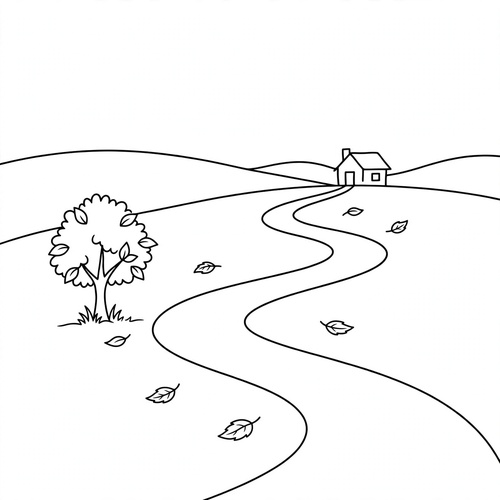
Open path through landscape toward distant little house
1.2 Separate your association from a universal rule
Use personal wording such as, “These leaves remind me of a time I enjoy.” That shares your association without claiming that leaves mean the same season to everyone. Someone else may connect them with another experience or no particular time.
Avoid inferring an answer from where a person lives, their family, or an assumed tradition. A location does not make someone a representative of a climate or culture, and a four-season model need not become the standard. Let people describe their response if they want to.
2. Invite another view if the person wants to share
Invite a view only if the other person wants to offer it. A short exchange needs no personal story or cultural explanation. The goal is simply to notice another possible reading.
2.1 Ask what the cue brings to mind
You could ask, “Does anything in this picture bring a season or moment to mind for you?” The person may name a detail, say nothing comes to mind, or decline to answer. Accept each as a complete response.
The same approach works while browsing printable coloring pages together. One person may react to a window, another to a path, and another to leaves. You do not need their location or history to make the exchange useful. One visible feature can be enough. The question offers another way to look at the drawing; it is not a request to explain someone’s background.
2.2 Listen without checking for the expected answer
If their answer differs from yours, acknowledge it in the terms they used. Someone may focus on outdoor play while you notice a window. You can ask one voluntary question about the named detail, but avoid steering the answer toward your expectation.
There is no need to decide which association is more seasonal or accurate. Nor should someone speak for a place or group. Listen to what this person chose to share.
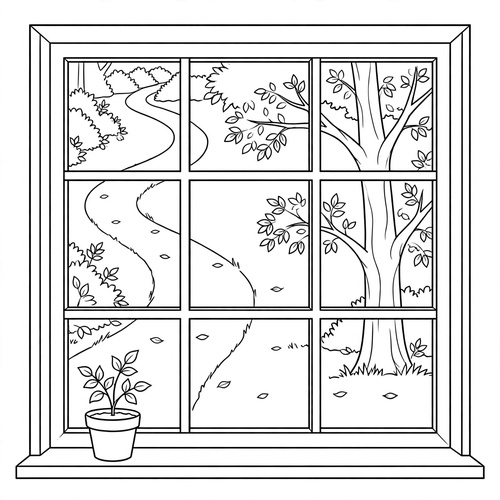
Large window view of tree and peaceful path from inside
3. Turn a difference into another discovery route
A different association can open a new direction for browsing. Follow it when it interests you, without treating another person’s view as a choice you must adopt.
3.1 Follow the newly noticed setting or subject
Perhaps you have been looking at outdoor landscapes, then someone mentions a window. That detail may make you curious about indoor viewpoints you had not considered. The discovery route comes from a visible cue, not an assumption about the speaker’s background.
Inspect actual drawings for the feature. A window framing another view might appeal, while an interior without that relationship may not. The idea widens where you look; it does not prove an exact motif is available.
Imagine two people looking at the same autumn-style scene. One notices a road disappearing behind trees; the other returns to a small house. After a brief exchange, one searches for open paths while the other explores indoor scenes. Neither changes the other’s interpretation, but both notice something they had missed.
3.2 Keep separate preferences instead of seeking a winner
One person can choose a broad outdoor scene while another chooses an interior view. Either may keep the original picture or stop browsing. The final drawings do not need to form a set, represent one common season, or prove that somebody’s interpretation won.
Understanding another association can still be useful. It may explain what that person noticed. Keep the endpoint attached to each person’s interest rather than requiring agreement.
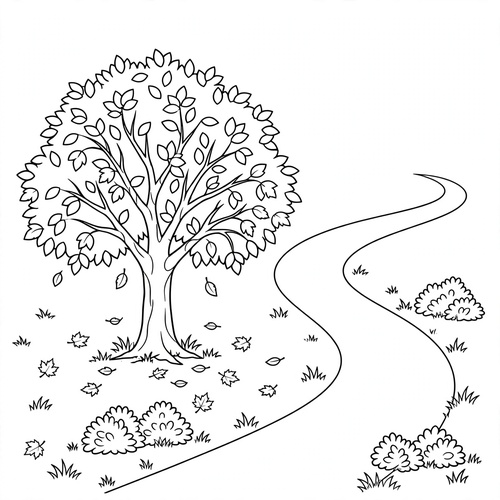
Tree beside curved path with fallen leaves and bushes
Useful Reference:
ColoringPagesCreative Makes Coloring Time Feel Warm and Free
Printable Coloring Sheets For Kids Ready To Explore New Ideas
4. Choose what you want to carry into coloring
An association heard during browsing can remain only an idea. Decide whether you want to carry it into coloring, and let that decision stay separate from appreciating the exchange.
4.1 Use an idea only when it interests you
You might see an open path as the beginning of an imagined seasonal walk. If that connection appeals, keep it in mind while you color. You do not need to tell a story, add another design, or explain your choices.
You can also appreciate hearing the association and leave it unused. The exchange has not created an assignment. Ask yourself:
- Does this idea make the picture more interesting to me?
- Does it help me notice a feature I want to explore?
- Can I leave it aside without affecting the activity?
If the idea adds nothing you want, attention to the picture can remain enough.
4.2 Leave the interpretation open while you work
The interpretation can stay private or change while you work. A scene that first suggested a remembered time might later become a group of shapes you enjoy coloring. Another idea does not have to replace your earlier choice.
There is no correct palette, cultural reading, or shared explanation to preserve. Another person’s association was an invitation, not an instruction. Let the visible picture and your interest guide what you do, even when the seasonal label becomes less important.
5. Find coloring pages for your chosen activity
ColoringPagesCreative brings seasonal resources together through homepage collections and discovery sections. Because people may notice different cues, an exchange can reveal a setting or subject you overlooked. Use that association as a discovery lead while keeping your choice independent.
When you open coloring pages for printing, inspect the individual resource rather than relying only on a category label. Confirm that the drawing matches the feature you want, then check the offered format, paper guidance, and usage terms for your planned action. A seasonal association can guide discovery, but it cannot confirm practical details.
5.1 Use the observed discovery sections as starting points
Use the observed discovery sections as starting points, then inspect the actual image at a useful size. If an association has made a window, path, leaf pattern, or indoor setting interesting, look for that feature and its relationship to the rest of the drawing.
Let the picture confirm the connection rather than assuming a section label guarantees it. Another person can follow a different cue. This keeps browsing flexible and avoids treating a broad seasonal category as a promise that every image matches one interpretation.
5.2 Verify the drawing and the use you plan
Check the chosen resource’s access route, offered format, stated paper guidance, and usage details for the action you have in mind. If the idea involves sharing a copy or image, verify that use specifically. A seasonal connection does not establish those practical details.
When essential information is unclear, hold that action or choose a clearly supported alternative. Then proceed without needing everyone to share one interpretation.
Use seasonal coloring pages to notice one association you hold and, if another person wants to share, hear a different one. Follow a new cue only when it appeals to you. Check your chosen resource and keep each person’s final drawing and interpretation independent. The useful outcome is a wider set of possibilities.